Call Garry at
314-567-2060
I'm guessing that some people think, okay, the best way to take care of this problem is to kill the squirrels, for example. Can you speak to that?
Garry - Sure. I think the best thing people should realize is that you probably don't have an infestation of any specific animal. Obviously, animals breed to meet the need of the environment.
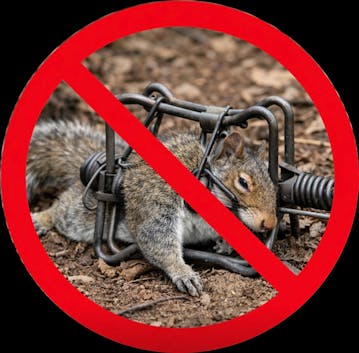
Commonly what is most true is that you might have an individual family group. When people use traps or relocation or lethal means in some way, often you are orphaning young in an attic.
The primary reason that a squirrel or raccoons or others are in our homes is actually for a nursery opportunity.
That is the primary reason. It is true they may be there for other reasons, but most times if there's a wild animal in your attic or soffit or chimney or any of our structures, it is primarily for a nursery opportunity. And so what happens, unfortunately, when people set traps, A, you don't know if you're even catching the target animal.
Traps are indiscriminate. They will catch just about anything. But furthermore, if there happen to be young in the attic and you get rid of the parent, you're going to have a bigger problem because the young, depending on what stage of development they are at, may or may not be able to even get out on their own. Certainly without mom present, they also aren't being taught where the resources are.
Generally speaking, wildlife, squirrels are no exception, are going to have multiple backup plans.So it's not that they have a mortgage like you or I do. They're not tied to one specific spot. In most cases, wildlife will have multiple den sites.
A veteran squirrel and wildlife pro reveals the hidden error homeowners unknowingly repeat
–with a specific approach that finally ends the problem.
St Louis Squirrel Control and Removal
(The brief interview below is pure gold for anyone that wants to avoid common but costly, ineffective squirrel removal methods and benefit from a long-term solution.)

This dialog recorded from my iPhone and transcribed a few days later with Garry Guinn's permission in January of 2026 –
Hey, Garry, it's Tim.
Garry - Hey, Tim, good to hear from you.
Tim- Can you hear me okay?
Garry - I sure can.
Tim - All right, so we're going to cover the topic of squirrels, and for your typical customer with a concern, what do you often find are the common perceptions compared to reality?
Well, truly, the animal found its way into this niche, this resource, this area,and it has learned where the resources are, and it's exploiting those resources.
It has nothing to do with you or your house at all. It really is more about controlling the problem, and in the case of an animal in your house, it has to do with the entry point.
Tim -Wow, those are great points. Thanks so much for sharing that.
I'm guessing that there are some people and companies that approach this topic from a whole different place, just killing animals, which is a really short-term and damaging solution versus everything you shared.
Garry - It's a way to profit. It's a way for them to generate revenue And it’s using your fears against you, unfortunately. There is no reason to fear an animal.
Obviously, give them their space, fix the holes in your house, and learn to live and let live, so to speak.

Tim - Well, I hope people will call a source like you because they're getting a holistic solution instead of just another problem disguised as a fix.
Thanks so much for sharing. I think people are going to get a lot of great value from this.
Garry - Absolutely. It was my pleasure speaking with you today.
Garry - If I may add just one thing. Humans are one piece of the greater puzzle. As humans, we kind of have it in our mind that we are the most important thing on the planet. Wildlife will do just fine without us. We will not survive without wildlife.
You have to remember that these systems, these environmental systems have been in place for generations, decades, eons, millennia. So these systems are created, one, squirrels plant trees. They help with our water quality by inadvertently leaving nuts in the ground, therefore a tree grows.
They also help to prune our trees and bushes. You wouldn't think that that's important, but just simply chewing off a little bit of a leaf here or there or a stick end helps to spawn additional plant branch growth. They serve a purpose.
They also, by the way, squirrels, will eat fleas and chiggers and ticks and mosquitoes. Obviously, they specialize in mast* products, but there is a benefit to them. Any animal that you would look at, it's really easy to vilify them because they are somehow impacting you in a way.
(* Mast is a broad term that refers to the various nuts and fruits produced by woody plants.)
They're causing you a problem, but really they don't care about you at all. In fact humans are, sir, you're a lovely fellow, but you're the scariest thing on the planet. They don't want anything to do with you.
They just want to utilize the resources, have a safe place to go, and create young. Does that sound familiar? Humans want those same things. And so, unfortunately, people will find that this animal is invading my territory or it doesn't belong here.

Garry - Yeah, no kidding. I mean, no matter what your opinion is of wildlife, nobody wants dead animals in their house. And, you know, just like when you were a kid, your parents taught you where the best grocery stores were, where the safe places are, who to go to if you need help.
Wildlife is no different than us in a lot of ways because the parent is also the primary teacher for them. And so mom has learned, whether it be through her parents or her grandparents, where the safest places to hide, where are things that we can find, where and how do we find certain foodstuffs.
Hey, here's my leaf nest or my oak tree that is separate from the attic per se. Squirrels have been found to have multiple den sites. And so especially different times of the year, you may hear different activities. So commonly people will say, oh, well, I saw 15 squirrels.
Well, that could be three separate families as the young grew up. Of course, they hang around for a little while learning those lessons. Then as they get old enough, the males are certainly ejected from the territory.
Nature has a way to try to prevent inbreeding. And so those males will almost certainly be ejected from the immediate family group's territory. But then further, the daughters and granddaughters and things, they may stick around, but they also need their general amount of resources.
Just by simply removing them, you're not going to see less animals. The only caveat to that is if you get to what's called the tipping point. So if you kill a certain amount of animals or remove them or whatever your predation, amount is, as you are getting beyond what's called the tipping point, which in the case of squirrels could be as high as 80%.
So effectively you would have to kill 80% of the animals of that species in your entire region, therefore seeing where the population cannot rebound.
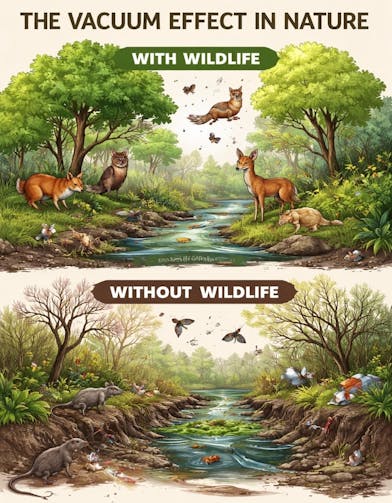
However, as that predation continues or if it wanes or stops, animals then will move into the area, the vacuum effect, or the remaining species there will then begin to repopulate.
So, again, it's not about the animal, it's about the resource. So address the issue, not the animal, therefore addressing the animal issue.
In the case of squirrels specifically, the primary reason that they are in an attic is a nursery opportunity. Now, they could be in there pre-nesting or they could be in there, you know, re-energizing a nest that was there previously.
And frankly, most people don't even realize they have a wildlife issue until . . . , you don't know what you know until you know it and then that's all you know.
So unfortunately, people will feel like they are being invaded or something like that. Frankly, you don't have a wildlife issue, you have an entry point issue.
What I mean by that is that animals generally don't make a hole except for in the case where maybe you closed a hole and didn't realize there were young there.
That could be from a builder concern. Maybe the builders left open a gap intentionally for any number of reasons or they were only building it to be pretty, not necessarily wildlife proof.
And so a lot of times, animals get blamed for making these holes. But ultimately, I would say the animal helped you identify where a hole is that maybe you weren't aware of in the first place.
I will even go a step further, is that the only thing that stays the same is that everything changes.
And rarely do people look at their roof or their soffit or fascia or other areas, attic side vents, roof vents, etc.
Also, with expansion and contraction, you will have situations where nails might wiggle free or something like that, causing the fascia to then be weaker. And so, again, you don't have a wildlife issue. You have an access point issue.
What happens is that, you know, water made the Grand Canyon, squirrels did not. What I mean by that is that water will rot boards or over time can cause something to weaken a little bit. And then that will cause that structure or material to begin to fail.
If that's the case, then, you know, parents want to get back to their babies. And so unfortunately, if you close a hole prematurely, you then might see where a squirrel does chew in. But in most cases, animals find a hole and then they will exploit it to suit their needs.
Note: If You just read the main interview above, you may not look at squirrel removal or animal problems in the same way ever again.
I consider it to be some of the best info found anywhere on the topic.
Towards the end, Garry added this big-picture perspective (below) that helps reshape the lens through which we can understand the environment and our place in it.
Well worth the one-minute read . . . .
From Squirrels to Survival: How Nature’s Smallest Players Keep Our World Alive
So ultimately, it goes back to the structure being correctly addressed after the animals are evicted. Your initial question was, you know, what happens when people just simply kill animals or squirrels specifically?
You could be orphaning young. You could be triggering what's called compensatory reproduction.
Compensatory reproduction is, you know, animals breed to meet the needs of the environment. If you were supposed to have 50 squirrels in your neighborhood because of the resources that are present, food, shelter, and predation are the three common factors that govern how many animals can be in your area. And that's actually called the carrying capacity.
So your environment can hold a certain amount of wildlife based on the food and shelter available. And then you would think by removing them that that would solve the problem.
But actually, the converse is true. As you start to remove wildlife from the area, either A, you're causing the vacuum effect.
If it was good for one animal, it will be good for another. Or you could be triggering that compensatory reproduction response.
And especially in the case of rodents, they can sometimes elevate their litter size. Nature has a way of saying, hey, there's supposed to be 50 squirrels here. You got rid of 20 of them.
Well, now we need to rebound and make sure there's enough squirrels to be sustained here.
It's not that nature directly says you should have that many, but because the environment can sustain X amount of wildlife, as you remove them, it's counter to what you might expect.
Tim - That's fascinating because I think a lot of people have an idea that without knowing the field, as you do, they think, well, the most permanent solution is just to kill the animal because the animal is killed permanently. And in fact, you're showing that the exact opposite is true.
I'm also thinking of when, in the case of squirrels, if someone goes for a lethal, what looks like a solution, which is the opposite of one I guess, they're often also possibly leaving young that may have no way to survive.
Then they've got dead animals in their attic or wherever they are, which is a whole other additional problem.
Tim - Yes, it makes a lot of sense.
I think people are going to get a lot of value from this. I find it very eye-opening. Having spoken to you before about squirrel control and other animals, your knowledge on this is super valuable, and I think people are going to get a lot from it.
So thanks so much for just sharing that. It's very helpful from a human perspective, and it's helpful from an environmental perspective, because we do live on a planet with all kinds of life forms, and it would be great to solve a problem in a way that is a win-win instead of a lose-lose, which is how some companies and people address the problem.
So thanks so much. I really appreciate this interview.
There can only be as many animals as the environment can support.
If you want to get rid of every squirrel in your area, you better cut down every tree and get rid of every flower and remove every bird feeder, etc. Well, those are not pragmatic solutions.
You might as well live on the moon if you don't want any more squirrels because on the moon, there are no trees and other foodstuffs, if that makes sense.

Note - Garry's company is called Humane Wildlife Solutions LLC and it serves St Louis County and City areas.
He has dedicated his working life to the effective management of squirrels and other wildlife as it relates to homes, buildings, and in the bigger picture of communities.
Call Garry at
314-567-2060

Contact at 314 567 2060
Squirrel Problems?
This brief interview from a St Louis area wildlife expert shows why traps, poisons, and ‘repellents’ quietly fail—and the one method that actually works when nothing else will.
Call Garry at
314-567-2060



In case it's helpful for your situation, this is a reputable online resource for many kinds of wildlife–
Fortunately there are non-lethal yet effective ways to deal with wild animals coming into a home or business.
Serving these Missouri counties in or near St Louis -
St Louis County, St Charles County, Jefferson County,
Franklin County and Washington County
See the whole topic rolled into an info-graphic on
See the whole topic rolled into an info-graphic on
If you'd prefer to listen, use the blue button
See the whole topic rolled into an info-graphic on
"You don't have a wildlife issue, you have a hole in your house" -Garry Guinn